How to Avoid Amazon LTSF Sweeps in 2026: The Data-Driven FBA Restock Strategy
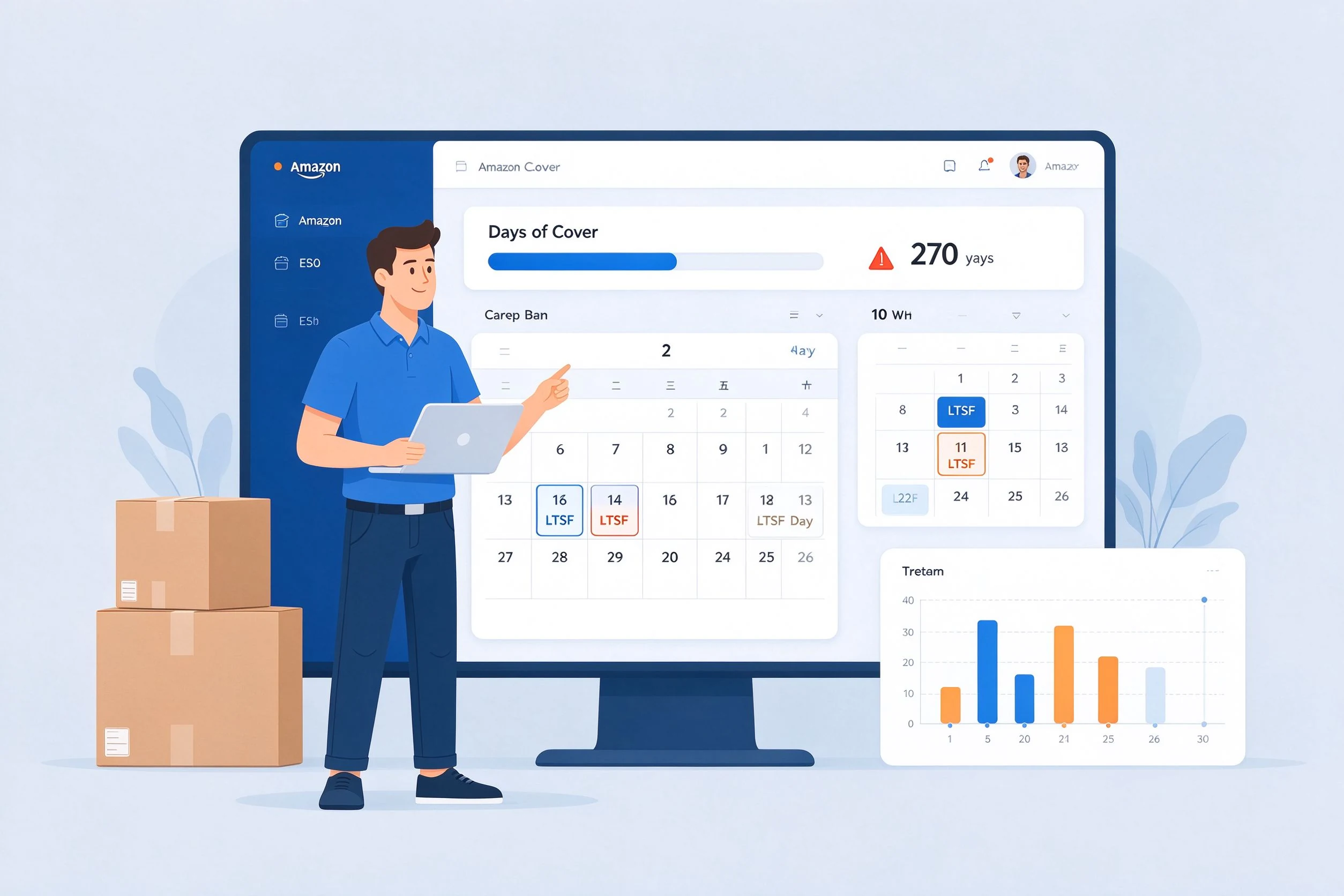
Why LTSF sweeps are the 2026 profit killer
For Amazon FBA private label sellers, inventory management is a delicate balancing act. Stock out, and you lose your Best Seller Rank (BSR) and organic keyword momentum. Overstock, and your hard-earned net profit margins vanish into Amazon's bottomless fee structure.
In 2026, warehouse space remains at a premium, making the Aged Inventory Surcharge (Long-Term Storage Fee / LTSF sweeps) a major financial risk for inventory sitting over 270 days.
Managing the 270-Day Cliff and Days of Cover (DoC)
To avoid severe penalties, sellers must move beyond past sales volumes and focus on forward-looking metrics like Days of Cover (DoC) to account for seasonality and supply chain shifts.
Many new sellers make the mistake of restocking purely from past sales volumes. Past wins do not account for seasonal swings, new competitors or supply chain delays. Days of Cover tells you exactly how many days your current inventory lasts at real-time sales velocity — the metric that actually keeps you off the LTSF radar.
3 Actionable Tactics to Keep FBA Inventory Lean
1. Maintain a 60-Day DoC Buffer
Target 60 to 75 Days of Cover. Pause manufacturing for SKUs crossing 90 days, and liquidate items nearing 180 days before hitting the 270-day threshold.
- 90 days: any SKU crossing this mark should get an immediate production stop.
- 180 days: requires proactive sell-off measures before the critical 270-day boundary is reached.
2. Leverage Virtual Bundles & Discounts
Pair aging stock with high-velocity items or use tiered discounts to accelerate turnover while preserving average order value.
- Use Amazon's Virtual Bundles tool to link slow-moving aging units with your bestsellers.
- Or run tiered quantity discounts (e.g., "Buy 2, save 15%") — faster sell-through without crushing your average order value (AOV).
3. Run Cost-Benefit Analyses
Evaluate whether FBA liquidation fees are more cost-effective than upcoming aged surcharges for stock older than 240 days.
Use a free inventory restock calculator to track velocity and reorder points
You do not need an expensive software subscription to calculate reorder points and aging risk. Use local browser tools like an inventory restock calculator to track velocity and reorder points safely without risking private sourcing data.
Our tool runs 100% locally in your browser — your inventory, sales velocity and supplier lead time never leave your device. It instantly tells you your exact reorder point and visually warns you the moment your Days of Cover drifts into the 270-day danger zone.
Frequently asked questions
What is an Amazon LTSF sweep?
LTSF stands for Long-Term Storage Fees. Amazon performs periodic sweeps (February and October) of inventory aged over 270 days, charging a heavy per-cubic-foot aged inventory surcharge on top of normal monthly storage fees.
How do I avoid Amazon LTSF sweeps in 2026?
Target a 60–75 day Days of Cover (DoC) buffer, pause manufacturing for SKUs crossing 90 days, liquidate items nearing 180 days, and run a cost-benefit analysis for stock older than 240 days. Track reorder points with a free local inventory restock calculator.
What is Days of Cover (DoC) in FBA restocking?
Days of Cover (DoC) is how many days your current inventory will last at your real-time sales velocity. It is the forward-looking restock metric that accounts for seasonality and supply chain shifts, unlike past sales volume.
Can FBA liquidation save me from aged inventory surcharges?
For stock older than 240 days, compare Amazon FBA liquidation (which often recovers 5–10% of item value) against the upcoming aged inventory surcharge the stock will trigger past 270 days. The cheaper option depends on your category and item value.